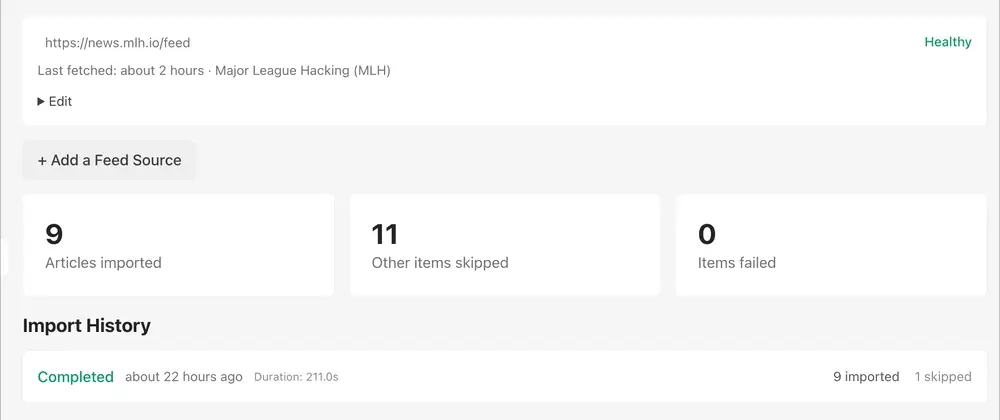
You can now add multiple RSS feed imports, monitor their status, and assign each one to different default authors or organizations.
DEV (and Forem) have supported RSS feed imports for a long time. They are the primary way to automatically distribute posts from an external blog to the DEV community, with appropriate canonical URL references to preserve your SEO rankings. Historically, each user was limited to one RSS feed that they could sync with DEV.
Let's take a look at the new improved functionality. If you go to the RSS Import Feeds page in your Dashboard, you can add your first RSS feed from your (or your team's) external blog.
As part of the import process, you can set which organization in DEV these imported items will be associated with. You can also set a default author. If the author of the imported post does not have a DEV account, the article will appear under its default author.
You still have the same two options as before: Mark the RSS feed as the canonical URL by default (which we recommend doing for SEO purposes, unless you're completely moving your blog to DEV and shutting down the previous version). You can also replace self-referring links with DEV community-specific links: this option will update online URLs to point to the imported version of an article in DEV instead of the original version. This is useful if you are migrating your entire blog to DEV.
Once you've added your feed, a background job is queued to import your posts. Simply refresh the page a few minutes later to see the status. If it was successful, you will see a list of imported drafts in your Import History. You can also see which articles were skipped or deleted with errors. If there are no new items, it will be displayed in the routine checks drop-down menu at the bottom of the page.
Review each edited article, edit the draft, and publish your post. In some situations, you may need to publish it by modifying the markdown published label so that it is set to true instead of false. Saving it will publish the post.
In posts published with canonical links, you'll see a link back in the post's author line.
We look forward to seeing you distribute your blogs to the DEV community and welcome any feedback on features you have here!